
Littleton, CO · Roofing service
Roof Repair in Littleton, CO
Leaks, missing shingles, flashing failures and pipe boot cracks. Under 100 square feet it stays a repair, and we tell you where that line falls.
Most roof problems are not roof problems
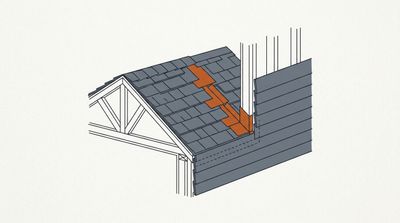
The majority of leaks we see in Littleton are flashing failures, not shingle failures. Water gets in where the roof meets something else: a chimney, a wall, a pipe, a skylight. The field of the roof is usually fine.
This matters because it changes the diagnosis and the price. A homeowner with a ceiling stain often assumes they need a roof. Frequently they need a pipe boot, a piece of step flashing, or a properly rebuilt chimney saddle.
The 100 square foot line
Littleton is unusually clear about where repair ends and replacement begins, and it is worth knowing because it protects you.
Removal or replacement of one square — 100 square feet — or less in aggregate is a repair. Above that, the job is classed as a roof replacement, which means full tear-off and the complete current code package.
Two consequences follow:
- A contractor cannot legitimately "repair" 300 square feet of your roof to avoid pulling a replacement permit. That is unpermitted work and it is your house it lands on.
- Equally, a contractor should not convert a 60 square foot problem into a whole roof. If the rest of the covering has life in it, a repair is the correct answer.
There is a third trap worth knowing: if the roof covering did not require a permit, but the area of sheathing needing replacement is large enough to require one, a roof permit must still be obtained.
What we repair, and what it usually is
Pipe boots
The single most common leak source on a Colorado roof. The rubber collar around a plumbing vent degrades under UV, cracks, and lets water straight down the pipe into the ceiling below. Cheap to fix, and frequently the entire cause of a stain a homeowner assumed was a failed roof.
Step and counter flashing
Where the roof meets a vertical wall. Done properly, each shingle course gets its own piece of step flashing woven in. Done badly, someone ran a bead of sealant along the joint and it failed within two seasons.
Chimney flashing
Older Littleton and Englewood homes often have flashing bedded into mortar and resealed repeatedly over decades. Each reseal buys less time than the last. At some point it needs rebuilding rather than recoating.
Valleys
Valleys carry the most water on the roof. Littleton specifies the treatment: closed valleys take ice and water barrier at least 36 inches wide, open valleys take one layer of 24-inch galvanized metal or two layers of mineral-surfaced rolled roofing.
Wind-lifted and missing shingles
Common after downslope events. Worth checking the fastening pattern on the surrounding shingles while we are up there, because shingles that lift in moderate wind are often under-nailed.
Ridge and hip caps
Exposed on two sides, so they weather and take hail damage faster than field shingles.
Why the sealant-in-a-tube approach fails
Roofing sealant has a place: it is a supplement to a mechanical detail, not a substitute for one. Nearly every long-term leak we open up has a history of sealant applied over a flashing problem.
It fails for a predictable reason. Colorado roofs go through enormous daily thermal cycling, expanding and contracting every day. Rigid sealant over a moving joint cracks. Water then gets in and is held there by the sealant, which is worse than the original leak because it keeps the deck wet.
The other DIY failure is walking the roof. Beyond the fall risk, walking a hot asphalt roof scuffs granules off and walking a cold one cracks shingles. People routinely cause more damage investigating a leak than the leak was doing.
Finding the actual source
Water does not enter where it appears. It runs along rafters, sheathing and top plates before it drops through a ceiling, sometimes for several feet. A stain in the middle of a bedroom can originate at a wall intersection well away from it.
So we work from both sides where we can: the attic, to trace the path back to the entry point, and the roof surface, to find the failure. Repairing the place where the stain is achieves nothing.
When we will tell you to replace instead
We will recommend against a repair when:
- The covering is brittle enough that lifting shingles to work breaks the ones around it.
- There are multiple leak points in unrelated areas.
- Granule loss is field-wide, meaning the whole covering is near the end together.
- The repair area would exceed 100 square feet anyway, which makes it a replacement by code.
In those cases a repair is money spent to delay a decision you have already effectively made. We would rather say so than take the work.