
Littleton, CO · Roofing service
Gutter Replacement and Repair in Littleton, CO
Seamless gutters and downspouts sized for Front Range cloudbursts and snowmelt, replaced alongside the roof so the drip edge detail is right.
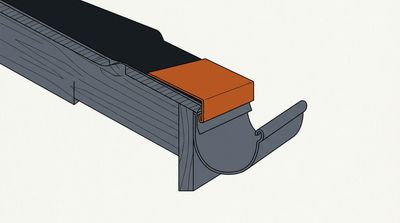
Gutters are the last few inches of the roof
Most gutter failures are not gutter failures. They are edge-detail failures: water getting behind the gutter because the drip edge, gutter apron and ice barrier were not built into a correct sequence at the eave. Replacing the gutter without fixing that repeats the problem with newer metal.
This is why we treat gutters as part of the roof rather than as a separate trade bolted on afterwards. The eave is one assembly. Roofing, flashing and gutter all meet there and the order they are built in determines where the water goes.
The drip edge requirement
Littleton requires drip edge flashing at eaves and rake edges of shingle roofs, installed in accordance with the applicable code and manufacturer instructions.
Drip edge does a specific job: it carries water off the edge of the deck and into the gutter, rather than letting surface tension pull it backwards onto the fascia. Without it, or with it installed in the wrong order relative to the underlayment, water tracks behind the gutter every time it rains.
The result is rotted fascia, stained soffit and sometimes wet wall framing — on a house whose gutters look perfectly sound from the ground.
Getting this right requires the roof edge to be open, which is why the sensible time to replace gutters is during a reroof.
The ice damming connection
Littleton requires ice and water barrier to ASTM D1970 extending a minimum of two feet inside the exterior wall line at the eaves of all conditioned structures.
That requirement exists because of ice damming. Heat escaping into the attic melts snow on the upper roof; the meltwater runs down to the cold eave, which overhangs unheated space, and refreezes. The ice ridge builds and subsequent meltwater backs up under the shingles.
Shingles shed water going downhill. They do not resist water being pushed uphill. The ice barrier is the layer that does.
Gutters get blamed for ice dams and are rarely the cause. A gutter full of ice is a symptom of the same heat-loss problem. What actually reduces ice damming is attic insulation and ventilation, which is why we look at ventilation during any roof work: net free ventilating area of 1/150 of the vented space, or 1/300 where the conditions for reduced ventilation are met.
Sizing for Front Range storms
Colorado summer storms are short and intense. A gutter system sized for steady rainfall overflows in a cloudburst.
Three things drive sizing:
- Roof area draining to each run. Not total roof area — the area that actually feeds that gutter.
- Pitch. Steeper roofs deliver water faster, so the same area needs more capacity.
- Downspout count and placement. Frequently the real constraint. A long run with one downspout at one end will overflow at the far end regardless of gutter size.
If your gutters sheet water over the front edge in heavy rain but are not clogged, you have a sizing or downspout problem rather than a maintenance problem.
Seamless, and why it matters less than people think
Seamless gutter is formed on site to the length of the run, so there are no joints along its length. That removes the most common leak point in old sectional gutter.
It is genuinely better. It is also not the thing that determines whether your gutter system works. Corners, outlets, downspout sizing, hanger spacing and the slope of the run matter more, and all of them are workmanship rather than product.
A seamless gutter hung with too few hangers will sag and pond. A seamless gutter with inadequate fall will not drain. Ask about hanger spacing, not just about seams.
Where the water goes after the downspout
Worth thinking about, because it is the cheapest problem on this page to fix and the most commonly ignored.
A downspout discharging at the foundation delivers a large volume of water directly against the wall. Colorado soils include expansive clays in places, and repeated wetting and drying cycles at the foundation are not a trivial matter.
Extensions or buried drains that carry water clear of the house are inexpensive relative to what they protect. We will flag it if we see it.
What we do
- Seamless aluminum gutter, formed on site, in the profile and size the roof actually needs.
- Correct drip edge and gutter apron sequence at the eave.
- Hanger spacing and fall set for Front Range rainfall intensity.
- Downspout sizing and placement reviewed against roof area, not copied from what was there.
- Gutter guards where trees justify them, and a straight answer where they do not.
- Fascia repair where water has already got behind the old system.