
Littleton, CO · Roofing service
Roof Inspections in Littleton, CO
A documented condition report covering decking, underlayment, ventilation and flashing, with photos you can keep and use.
What an inspection is actually for
A roof inspection tells you three things: whether there is damage, whether it needs addressing now or can wait, and what evidence exists to support an insurance claim if one is warranted. You should come away with photographs and a written assessment you keep, whether or not you hire anyone.
The word "free inspection" is used heavily in this industry, and the honest thing to say is that a free inspection is a sales call. That is not automatically bad — a sales call can still produce an accurate assessment — but you should know which one you are having, and you should be suspicious when the finding is always the same.
What we check
The covering
- Granule loss, measured by what is in the gutters as well as what is visible on the roof.
- Brittleness, cupping and clawing, which indicate the mat has lost its oils.
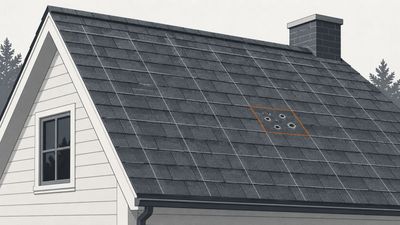
- Hail bruising, counted in measured test squares per slope so density and distribution are documented rather than described.
- Wind lift and fastening. Shingles lifting in moderate wind are often under-nailed, which matters given Littleton's six-nail requirement.
The soft metals
Vents, flashings and gutter aprons. These are the most reliable evidence on the whole roof because a dent in aluminum does not appear with age. If the soft metals are clean after a claimed hail event, that tells us something important.
The penetrations and intersections
Pipe boots, chimneys, skylights, wall intersections and valleys. This is where most leaks actually originate, so it gets the most attention.
Ventilation
Intake and exhaust, and whether the balance is right. Littleton does not allow ventilation to be reduced below existing conditions, and where the code requires it, net free ventilating area is 1/150 of the vented space, or 1/300 where all conditions for reduced ventilation are met.
Poor ventilation cooks shingles from underneath and shortens roof life considerably. It is one of the few findings that explains why a roof aged faster than it should have.
The attic, where accessible
Daylight through the deck, staining on rafters and sheathing, the condition of the decking itself, and any evidence of past leaks that were repaired without the cause being found.
The attic is also where we can sometimes see what kind of sheathing you have, which is the single biggest unknown on the cost of any future replacement.
What you receive
- Photographs of every slope, labelled by orientation.
- Close photographs of any damage found, and of the soft metals.
- Test square documentation where hail is suspected.
- Photographs of areas that are sound.
- A written summary: what we found, what it means, what we would do and in what order.
- A view on remaining service life, stated as a range rather than a number.
This is yours to keep and to show to anyone else, including a competing contractor.
Timing
After a storm
Front Range hail season runs roughly mid-April to mid-September. Get the roof looked at after a significant event even if nothing appears wrong, because hail damage is mostly invisible from the ground and policy time limits apply to claims.
Before buying a house
A dedicated roof inspection during your due diligence period is worth the cost on any house where the roof is more than ten years old. Ask specifically whether there are open or unpermitted roofing permits on the property.
Before selling
Find out what the buyer's inspector will find, before they find it. Open permits are the other thing worth resolving early: a final inspection is required to close a Littleton roofing permit, and one that was never closed is a problem at closing.
Annually, otherwise
Particularly on roofs past year ten, and particularly if there are trees close to the house.
Why not just look at it yourself
From the ground, you can spot missing shingles, obvious sagging, and granules at the downspout. That is genuinely useful and worth doing a couple of times a year.
What you cannot do from the ground is assess hail bruising, which is the damage that actually decides whether you have a claim. And walking the roof yourself is a bad trade: aside from the fall risk, walking a hot asphalt roof scuffs granules off and walking a cold one cracks shingles.