
Winter
Ice Dams on Front Range Homes: What Actually Stops Them
Almost everything sold as an ice dam solution treats the symptom. The cause is warm air leaving your house through the ceiling, and until that changes, the ice comes back every winter.
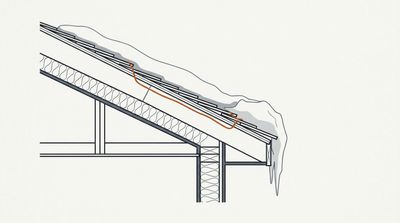
Every February we get calls about ice on roofs, and most of them start with a question about gutters. Gutters are almost never the problem.
The mechanism, properly
Warm air escaping into the attic heats the roof deck from underneath. Snow on the heated section melts. The meltwater runs down to the eave, which overhangs unheated space and stays at outside temperature, and refreezes there. The ice ridge builds, and subsequent meltwater pools behind it and is forced under the shingles.
Three conditions have to coincide, which is why some houses dam and their neighbors do not:
- Snow on the roof.
- A roof surface above freezing over heated space.
- A roof surface below freezing at the eave.
Colorado supplies all three generously. Heavy snow, then a sunny afternoon, then a night well below freezing, repeatedly.
Why shingles cannot help you
This is the part worth understanding, because it explains why a new roof on its own does not solve the problem.
Shingles are a shedding system. Each course overlaps the one below, so water running downhill passes over the joints and off the edge. The system works entirely because of gravity and direction.
An ice dam reverses the direction. Standing water behind the ridge gets pushed uphill by pressure and capillary action, and once it is moving up, every overlap becomes an opening and every nail penetration becomes a path.
A brand new shingle roof behaves exactly the same way. The covering is not the defense.
What the code does about it
Ice barrier is the code's answer, and the requirements around Littleton vary dramatically:
- Cherry Hills Village: ice barrier in place of standard underlayment, because of the Village's ice-damming history.
- City of Littleton: ASTM D1970, at eaves of all conditioned structures, extending two feet inside the exterior wall line.
- Jefferson County: required for asphalt, metal shingle, mineral roll, slate, wood shingle and shake.
- Douglas County: only above 7,000 feet elevation.
- City of Lone Tree: not required.
The full comparison, with sources →
Note what the membrane does and does not do. It seals the deck against water pushed uphill, so when a dam forms the water has nowhere to get in. It does not stop the dam forming, and it does not protect anything beyond its coverage. Water backing up past a two-foot band finds ordinary underlayment above it.
The actual fix: stop the heat
Ice damming is a building envelope problem that happens to show up on the roof. Three things, in order of impact:
1. Air sealing
Warm air leaks into the attic through penetrations, and it carries far more heat than conduction through insulation does. The usual culprits:
- Bathroom extractor fans venting into the attic rather than through the roof
- Recessed light fittings penetrating the ceiling plane
- Gaps around plumbing stacks, wiring runs and chimney chases
- The attic hatch itself, frequently uninsulated and unsealed
- Dropped soffits and bulkheads open to the attic above
This is usually the cheapest intervention and the highest return. It is also the one nobody sells you, because there is no product in it.
2. Insulation
Once the air leaks are sealed, insulation depth reduces conductive heat loss. Sealing first matters: insulation laid over open penetrations does very little, because air moves straight through it.
3. Ventilation
Ventilation keeps the attic close to outside temperature, so the roof deck stays uniformly cold and the snow does not melt unevenly.
Littleton requires that roof ventilation not be reduced below existing conditions, with net free ventilating area of 1/150 of the vented space, or 1/300 where all the conditions for reduced ventilation are met, including the required distribution of upper and lower ventilation.
That distribution requirement is the part that gets botched. Ventilation is a system: intake low at the soffits, exhaust high at the ridge, air moving between them. Adding ridge vents without adequate soffit intake does not improve airflow — it can pull conditioned air out of the house instead, which makes the problem worse.
More on getting ventilation right →
What not to do
- Do not chip ice off the roof. You will damage the covering, and on a cold day shingles crack rather than flex.
- Do not use salt or de-icer on shingles. It degrades the covering and corrodes metal flashings and gutters.
- Do not get on an icy roof. Genuinely dangerous, and every winter people do it.
- Do not accept sealant as a leak fix. Sealant over a flashing joint fails in a freeze-thaw climate, and it traps water against the deck while it does.
If it is happening right now
- Contain water inside. Buckets. If a ceiling is bulging, a small hole lets it drain in a controlled place rather than bringing the whole thing down.
- Photograph everything, inside and out, including the ice itself. It will melt, and the photographs are what an insurer sees.
- Clear snow from the lower roof if you can do it safely from the ground with a roof rake. Removing the snow removes the fuel.
- Note exactly where the ice is. That location is telling you where the heat is escaping, and it is the most useful diagnostic you will get all year.
- Call once the immediate risk is handled. The repair and the cause are two separate jobs.
The honest summary
If your house dams ice every winter, a new roof with ice barrier will reduce the damage and will not stop the ice. The ice will come back next February.
Air sealing and ventilation are what actually change the outcome, and they are usually cheaper than the roof. Any roofer who quotes you a replacement for an ice dam problem without once mentioning your attic has sold you a covering, not a solution.